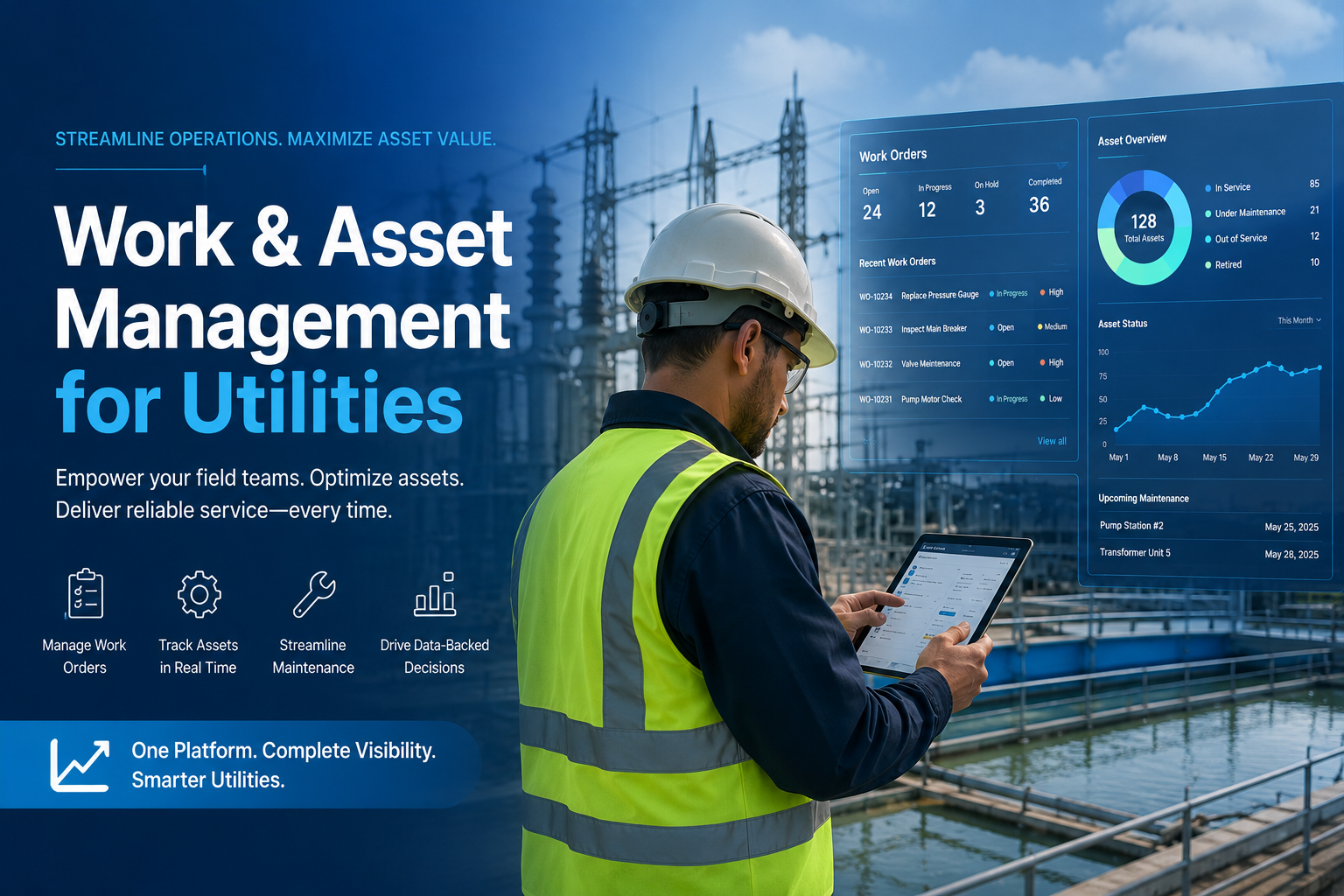
Work and asset management for utilities is the practice of planning maintenance, scheduling crews, and tracking the full life of physical assets like pipes, cables, transformers, and pumps in one connected system. Done well, it moves a utility from fixing things after they break to servicing them before they fail, which lowers costs, reduces outages, and extends the life of expensive infrastructure.
This guide explains what work and asset management really means for a utility, the benefits and the honest challenges, the numbers that tell you it is working, and how to run all of it on Microsoft Dynamics 365 without the price tag of a heavy enterprise platform.
What is work and asset management for utilities?
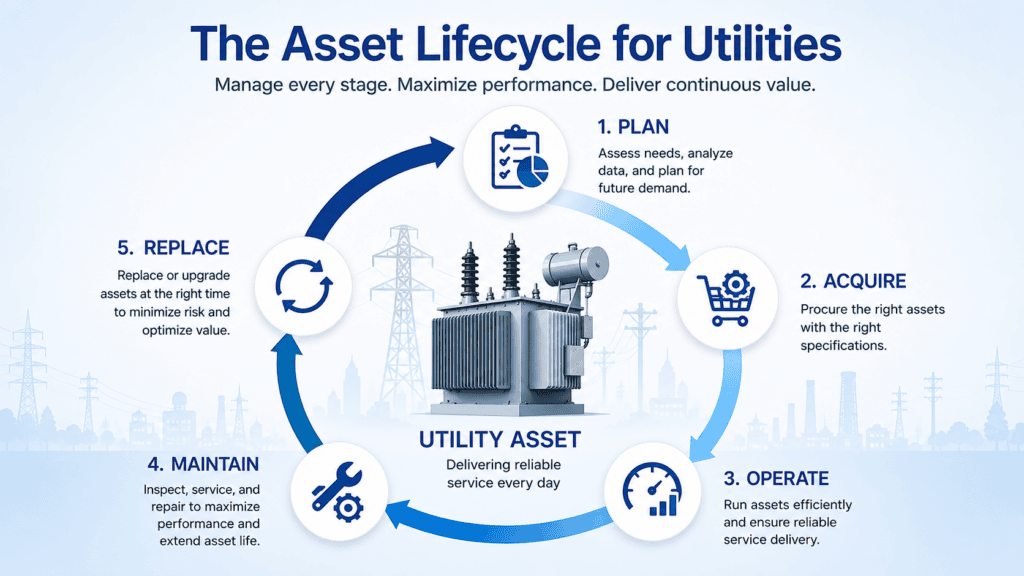
Utilities run on physical assets that are spread across a wide area and expected to last for decades. Many of these are “linear assets,” meaning they are defined by their length rather than a single location, such as power lines, water mains, and gas pipelines. Others are fixed points like substations, pumping stations, meters, and treatment equipment.
Work and asset management brings two things together:
- Asset management decides what work should happen and when, based on the condition, age, and risk of each asset.
- Work management makes sure that work is actually done on time, with the right crew, parts, and safety permits.
When these two run in one system, planners can see an asset’s full history, schedule the right maintenance, dispatch the crew, reserve the parts, and record everything against that asset for next time.
Work management vs asset management vs EAM vs CMMS
These terms get mixed up, so here is a plain breakdown:
- Work management is the day-to-day: work orders, scheduling, crews, and completion. It answers “is the right work getting done on time?”
- Asset management is the strategy: which assets matter most, what condition they are in, and what to invest in. It answers “what work should we do, and where is the risk?”
- CMMS (computerised maintenance management system) focuses mainly on maintenance and work orders. It is strong on the “work” side.
- EAM (enterprise asset management) is broader. It covers the whole asset life, and it ties in finance, procurement, compliance, and risk. Work and asset management for utilities usually sits inside an EAM approach.
For most utilities, the goal is not to buy the biggest EAM platform. It is to connect maintenance, crews, parts, and finance so nothing falls through the cracks.
Why work and asset management matters for utilities
The payoff is not abstract. A connected work and asset management approach helps a utility:
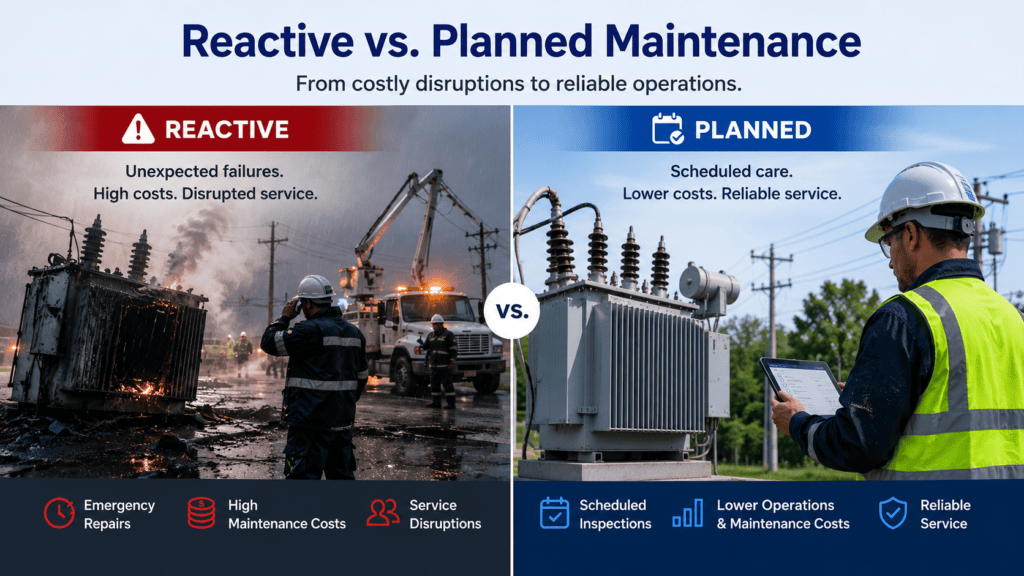
- Move from reactive to planned maintenance. Instead of chasing failures, teams service assets on a schedule or on condition, which raises the ratio of planned to unplanned work and cuts emergency call-outs.
- Extend asset life. Regular, recorded maintenance keeps ageing infrastructure running longer, so you delay expensive replacements.
- Reduce outages and downtime. Catching a failing transformer or pump early means fewer service interruptions and fewer angry customers.
- Control costs. Planned work is cheaper than emergency work. Better parts management means fewer rush orders and less money sitting in overstock.
- Prove compliance. A full digital record of inspections and maintenance makes regulatory reporting far less painful.
The biggest work and asset management challenges utilities face
It is worth being honest about what makes this hard, because the right system is the one that solves these:
- Ageing infrastructure and thin records. Much of the asset base is decades old, and its history often lives in spreadsheets, paper, or someone’s memory.
- Legacy systems that do not talk to each other. Maintenance, finance, and inventory sit in separate tools, so no one has the full picture.
- Field and office disconnect. Crews in the field cannot always see or update work orders, so data arrives late or not at all.
- Limited staff. Smaller utilities cannot spare people to run a complex system, so it has to be simple to use.
- Data and cybersecurity. More connected assets means more data to manage and protect.
Features to look for in utility work and asset management software
When you compare options, focus on whether the system can do these in one place:
- Asset register with full history for both fixed and linear assets, including location, condition, and cost.
- Preventive maintenance triggers based on calendar, meter readings, or condition, with work orders created automatically.
- Work order management with task lists, crew scheduling, parts reservation, and safety permits.
- Mobile access for field crews so they can view and close jobs on site, even offline.
- Spare parts and inventory linked to work orders, so the right parts are on hand without overstocking.
- Links to finance and procurement so maintenance costs, purchase orders, and budgets stay connected.
- Dashboards and reporting that show asset health and maintenance performance at a glance.
Your asset management module, service management, and inventory and warehouse management each cover part of this picture, and they share one database, which is the point.
The KPIs that show it is working
You cannot improve what you do not measure. These are the numbers utilities watch to know their work and asset management is paying off:
- MTTR (mean time to repair): how long, on average, to fix an asset after it fails. Lower is better.
- MTBF (mean time between failures): how long an asset runs before failing. Higher is better.
- Asset availability: the percentage of time an asset is ready to run.
- Planned vs unplanned work ratio: how much maintenance is scheduled versus emergency. More planned work is a sign of a maturing programme.
- Maintenance cost per asset: helps you spot the assets that cost more to keep than to replace.
- Schedule compliance: the share of planned jobs completed on time.
A good reporting layer, like the Olix365 reporting suite, turns these into dashboards for supervisors and CFOs instead of month-end spreadsheets.
How to run work and asset management on Microsoft Dynamics 365
Here is where most utility guides stop, because the big names (Oracle, IBM Maximo, Infor) point you at heavy, expensive platforms. There is a lighter path that many mid-sized utilities already have the foundation for: Microsoft Dynamics 365.
Dynamics 365 includes asset management, work orders, and preventive and predictive maintenance as standard, and it connects them to finance, procurement, and inventory in the same platform. That connection is exactly what solves the “systems that do not talk to each other” problem above.
Olix365 is a utility-ready solution built on Dynamics 365, so you get work and asset management shaped for water, gas, and electric operations without building it from scratch:
- One asset register for fixed and linear assets, with full history and cost.
- Automatic work orders from calendar, meter, or condition triggers, tied to crew schedules.
- Field-ready mobile access so crews update jobs on site.
- Predictive maintenance using sensor data, so you service assets before they fail. (See our guide to predictive maintenance for utilities.)
- Parts, procurement, and finance in the same system, so a work order, its parts, and its cost all line up.
For a utility already using Microsoft tools, this keeps training light and data in one place. To see the wider picture, read why utilities are moving to Microsoft Dynamics 365.
How to get started
You do not have to do everything at once. A sensible order is:
- Build a clean asset register first. List your critical assets, their location, condition, and history. This is the foundation everything else sits on.
- Set up preventive maintenance on your highest-risk assets. Start with the equipment whose failure hurts most.
- Put work orders in front of your field crews on mobile. Getting real data back from the field is what makes the whole system trustworthy.
- Connect parts and finance. So maintenance costs and stock levels stay accurate.
- Track a few KPIs from day one. Availability and planned vs unplanned work are good starting points.
Ready to see it in action?
If you want to move from reactive repairs to planned, data-led maintenance, Olix365 brings work and asset management together on Microsoft Dynamics 365, built for utilities. Book a free demo and we will show you how it fits your operation.
Frequently asked questions
What is the difference between work management and asset management?
Asset management decides what maintenance an asset needs and when, based on its condition and risk. Work management makes sure that work gets done on time with the right crew and parts. You need both, working together.
Is work and asset management the same as EAM?
Not exactly. EAM (enterprise asset management) is the broader approach that covers the full asset life plus finance, compliance, and risk. Work and asset management for utilities usually sits inside an EAM approach and focuses on maintenance and the crews who carry it out.
Do small utilities need work and asset management software?
Yes, and often more than large ones, because they have less spare staff to absorb emergency failures. The key is choosing a system that is simple to use and does not require a big team to run.
Can Microsoft Dynamics 365 handle utility asset management?
Yes. Dynamics 365 includes asset management, work orders, and preventive and predictive maintenance, and connects them to finance, procurement, and inventory. A utility-ready solution like Olix365 shapes this for water, gas, and electric operations.
Which KPIs should a utility track first?
Asset availability and the ratio of planned to unplanned work are the two clearest early signs of progress. Add MTTR and MTBF as your data improves.