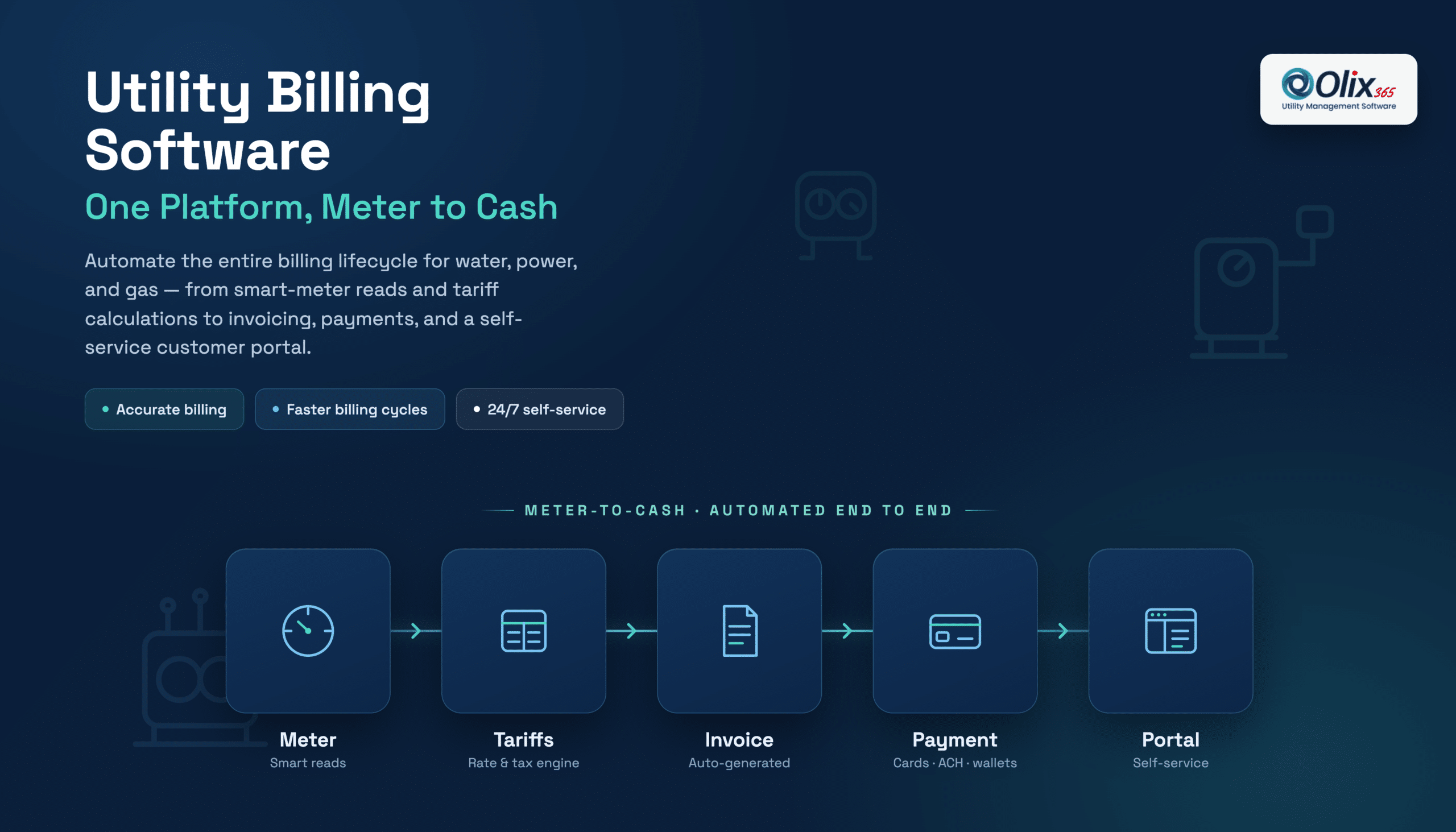
Quick answer: Utility billing software turns meter reads into accurate invoices and payments, the meter-to-cash cycle, for water, electric, and gas utilities. Olix365 runs billing on Microsoft Dynamics 365 Business Central, so billing, customers, finance, and operations sit on one platform instead of a standalone tool bolted onto your accounting system.
Every utility lives or dies on the accuracy of its bills. If rates are wrong, reads are missed, or payments do not reconcile to the ledger, revenue leaks and customers lose trust. Utility billing software is the system that manages that meter-to-cash cycle: importing consumption, applying rates, running billing cycles, issuing invoices, taking payments, and giving customers a way to see and settle their accounts.
This page is for utility finance and operations leaders evaluating a billing system. It explains what utility billing software does, the capabilities that matter for water, electric, and gas operators, and why running billing on one platform with the rest of your utility, rather than a point tool wired to a separate ledger, changes the total cost and the number of things that can break.

What does utility billing software do?
Utility billing software turns meter readings and service records into accurate bills, applies the correct rates, and gives customers a clear way to view and pay what they owe. For water, electric, and gas operators, it manages the full meter-to-cash cycle in one place instead of spreading it across disconnected tools.
A capable system covers six core jobs:
- Meter data and consumption: import reads from manual entry, AMR, or AMI meters and validate them before they reach a bill.
- Rates and tariffs: apply tiered, seasonal, and class-based rates, plus taxes and regulatory charges, without manual spreadsheets.
- Billing and invoicing: generate accurate bills on cycle and handle prorations, adjustments, and corrections with a full audit trail.
- Payments and collections: post payments, manage arrears, payment plans, and dunning, and reconcile against the general ledger.
- Customer accounts: keep service addresses, meters, deposits, and account history connected to every customer record.
- Reporting and compliance: track revenue, consumption, and aging, and produce the records regulators and auditors expect.

Why one platform beats a standalone billing tool
A standalone billing package can print a bill. But the moment revenue has to reach your general ledger, a payment has to post to an account, or a service order has to link to a customer, data has to move between systems. Every handoff is a place where numbers drift, reconciliations stall, and staff rekey the same information twice.
Olix365 runs utility billing inside Microsoft Dynamics 365 Business Central, so billing, finance, and customer service share one database. A payment posts once and is visible to the finance team and the front desk at the same moment. There is no overnight sync to wait on and no export-and-import step to reconcile.
That single-platform design shows up in three practical ways:
- One source of truth: meters, accounts, invoices, and payments sit in the same system as the ledger, so revenue and receivables always agree.
- Fewer moving parts: no middleware to maintain between a billing tool and the accounting system, which lowers the total cost of ownership and the number of things that can break.
- Room to grow: the same platform adds service management and a reporting suite when you need them, with no second vendor and no fresh integration project.

At a glance: point billing tool vs one platform
The real difference between a standalone billing tool and utility billing on one platform is not the invoice itself. It is everything that has to happen around the invoice. Here is how the two approaches compare on the points that drive cost and risk.
| What you are comparing | Standalone billing tool | Olix365 on one platform |
|---|---|---|
| Billing engine | Handles one utility type, usually water or electric | Water, electric, gas, and multi-utility accounts in one system |
| General ledger | Needs an export or integration to your accounting system | Native to the same Business Central ledger, with no sync |
| Payments and receivables | Reconciled separately, often on an overnight cycle | Posted once and visible to finance and the front desk at once |
| Customer and service data | Sits in a separate database from operations | Shared with service management and customer records |
| Reporting | Billing reports only | Revenue, consumption, and operations reporting across the utility |
| Adding new functions | A new tool or integration for each need | Procurement, assets, and projects on the same platform |
| Total cost of ownership | Licence plus middleware and reconciliation time | One platform with fewer integrations to maintain |
| Data residency | Depends on the billing vendor | Microsoft Azure regions, including Canada |
Billing for water, electric, gas, and multi-utility
Different commodities bill in different ways, and a utility that serves more than one needs a system that handles each without a separate tool. Olix365 supports the rate structures and read types that water, electric, and gas operators rely on, and it keeps every service a customer takes on a single account.
- Water and wastewater: consumption and flat-rate billing, meter-size charges, and sewer surcharges tied to water use.
- Electric: tiered and time-of-use rates, demand charges, and net metering for customers who generate their own power.
- Gas: volumetric billing with heating-value adjustments and seasonal rate changes.
- Multi-utility: one bill and one balance per customer across every service, with a clear line item for each commodity.
Because billing sits on the same platform as finance and service, a move-in, a meter change, or a rate update flows through to the ledger and the customer record with no rekeying.
Built for municipalities and Canadian utilities
Municipal utilities and Canadian operators work under rules that generic billing software rarely accounts for. Olix365 is built on Microsoft Dynamics 365 Business Central, so it inherits the compliance, security, and data-residency posture that Canadian public bodies expect, and it adapts to local billing and reporting requirements.
- Canadian data residency: data can be hosted in Microsoft Azure regions in Canada, which matters for municipalities with residency obligations.
- Local rates and taxes: provincial taxes, regulatory charges, and municipal fees are handled as part of the rate setup.
- Public-sector reporting: the finance and reporting tools produce the records councils, boards, and auditors ask for.
- Room for the whole operation: the same platform runs procurement, assets, and projects, so a municipality can consolidate systems over time.
If you run a municipal or regional utility and want to see how this maps to your billing, our team can walk through it with you. Request a demo and we will tailor it to your commodities and rate structures.
Key takeaways
- Utility billing software manages the full meter-to-cash cycle for water, electric, and gas: reads, rates, bills, payments, and collections.
- Running billing on one platform with finance and service removes the handoffs where numbers drift and staff rekey data.
- Olix365 puts utility billing inside Microsoft Dynamics 365 Business Central, so revenue, receivables, and customer records always agree.
- Multi-utility operators can bill every commodity on a single account, with one balance per customer.
- Canadian and municipal utilities get Azure data residency in Canada and the reporting their auditors expect.
Frequently asked questions
What is utility billing software?
Utility billing software calculates and issues bills for services like water, electric, and gas. It takes meter reads, applies the correct rates and charges, produces invoices, and tracks payments and arrears against each customer account.
What is the difference between utility billing software and an ERP?
Billing software handles the meter-to-cash cycle. An ERP runs the wider business, including finance, procurement, and service. Olix365 combines both by running utility billing inside Microsoft Dynamics 365 Business Central, so billing and the back office share one system.
Can one system bill water, electric, and gas together?
Yes. Olix365 supports the rate types each commodity needs and keeps every service on a single customer account, so a multi-utility customer receives one bill with a clear line for each commodity.
Does utility billing software work for small municipal utilities?
Yes. The platform scales from small municipal utilities to larger regional operators, and municipalities can add procurement, assets, and projects on the same system as they grow.
Is customer data stored in Canada?
Data can be hosted in Microsoft Azure regions in Canada. This helps Canadian municipalities and utilities meet data-residency requirements.
How does billing connect to the general ledger?
Because billing runs inside Business Central, invoices and payments post directly to the same ledger. There is no export, import, or overnight sync between a billing tool and a separate accounting system.
Can it handle tiered, seasonal, and time-of-use rates?
Yes. Rates can be tiered, seasonal, class-based, or time-of-use, with taxes and regulatory charges applied automatically during billing.
How do we move from our current billing system?
Most moves start with a review of your commodities, rate structures, and data. Our team maps those to Olix365 and plans the migration in stages. You can request a demo to start that conversation.
Bring billing and your utility together
Utility billing is not just about producing an invoice. It is about keeping reads, rates, payments, and the ledger in agreement while serving customers well. A standalone tool can print a bill, but it leaves you maintaining integrations and reconciling systems. Olix365 runs billing for water, electric, and gas on Microsoft Dynamics 365 Business Central, so the whole meter-to-cash cycle lives in one place with your finance and service teams.
If you are evaluating utility billing software for a municipal or Canadian utility, we can show you how Olix365 fits your commodities and rate structures. Request a demo and we will tailor the walkthrough to your operation.