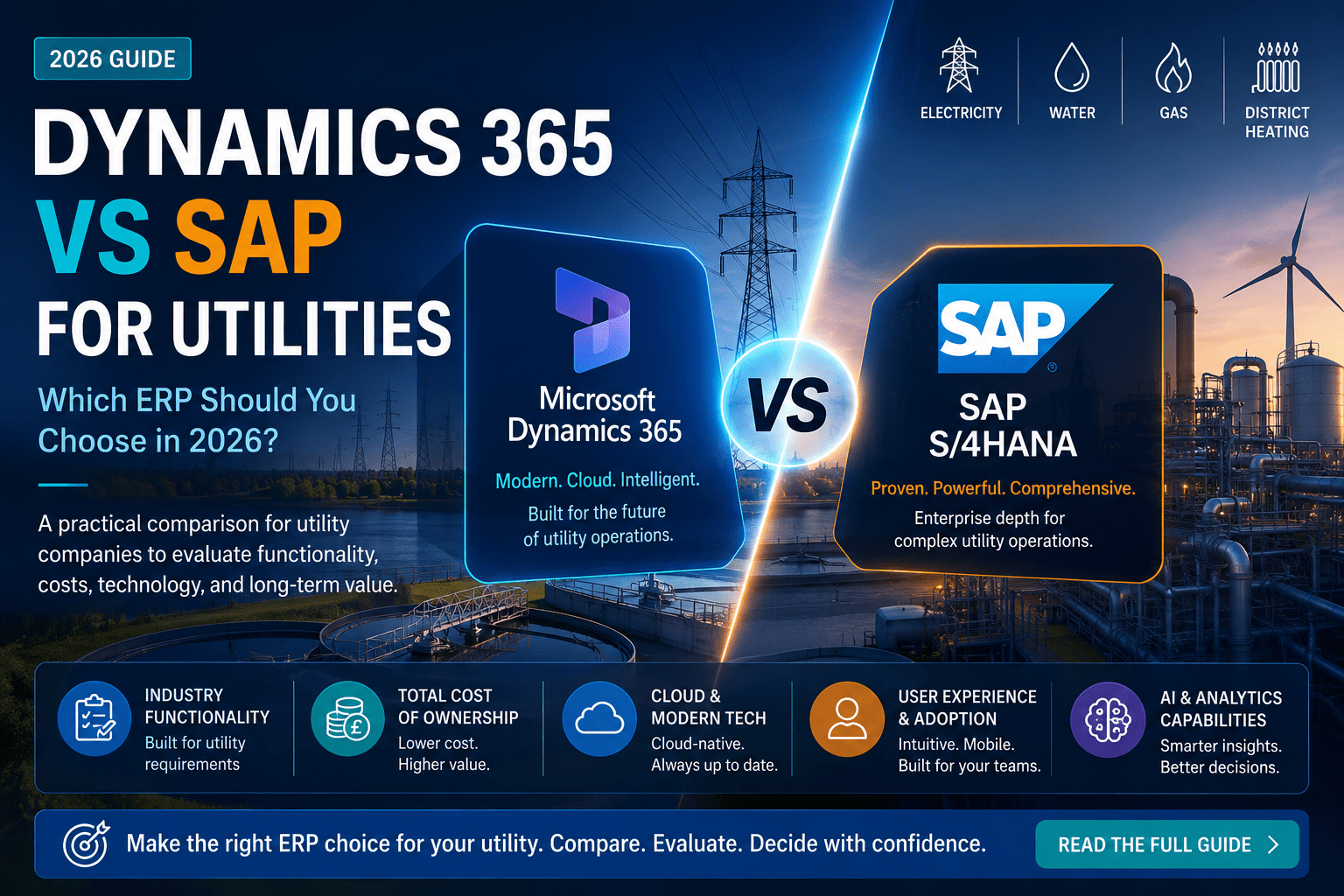
If you are in the market for a new ERP system for your utility company, the shortlist almost always comes down to two names: Microsoft Dynamics 365 and SAP. Both are capable, enterprise-grade platforms with established utility sector track records. Both will handle your finance, procurement, and asset management requirements. Both have large partner ecosystems and long-term vendor commitment.
So how do you choose? The answer depends on your organisation’s size, existing technology landscape, budget, and appetite for customisation and it is worth approaching the comparison with clear criteria rather than defaulting to analyst rankings or vendor marketing.
Important Note: Olix365 is a Microsoft Dynamics 365 partner, so we are not a neutral observer. We have included SAP’s genuine strengths and recommended scenarios where SAP may be the better choice, because the right answer for your utility is more important to us than a sale.
Head-to-Head Comparison: Key Criteria

1. Utility Industry Functionality
SAP: SAP has deep, purpose-built utility functionality through SAP IS-U (Industry Solution Utilities), SAP for Utilities, and more recently SAP S/4HANA Utilities. IS-U in particular has decades of development for complex utility billing, meter data management, and regulatory reporting. For utilities with highly complex billing requirements (time-of-use tariffs, cross-subsidy calculations, complex regulatory charges), SAP IS-U has historically been the gold standard.
Dynamics 365: Microsoft Dynamics 365 does not have a native IS-U equivalent for complex utility billing. However, the platform’s Asset Management, Field Service, Finance, and Project Operations modules are highly capable for utility operations, maintenance, and financial management. Partners such as Olix365 fill the billing gap with pre-built integrations to purpose-built utility billing systems. For utilities where billing complexity is managed by a separate Customer Information System (CIS), Dynamics 365 covers the remaining operational and financial requirements comprehensively.
Verdict: SAP is stronger for utilities with complex, high-volume billing requirements managed within the ERP. Dynamics 365 is stronger for utilities where billing is handled separately and the priority is operational efficiency, asset management, and financial control.
2. Total Cost of Ownership
This is where Dynamics 365 typically has a clear advantage for mid-market utilities:
For utilities with 50–500 employees, the total cost difference over a 5-year period can be £2–5 million. SAP’s higher cost is justified for very large utilities (1,000+ employees) where the depth of functionality and existing SAP landscape integration justify the investment.
3. Cloud and Modern Technology
SAP: SAP S/4HANA Cloud (public cloud) is available but many utilities run SAP on private cloud or on-premises, which means infrastructure costs and manual upgrade cycles remain. SAP’s transition from ECC to S/4HANA is a significant and costly migration that many utilities are still navigating.
Dynamics 365: Fully cloud-native (Microsoft Azure), with continuous updates (2 major release waves per year) that include new features without additional cost or upgrade projects. The Microsoft Power Platform (Power BI, Power Automate, Power Apps, Copilot Studio) is deeply integrated with Dynamics 365, providing a low-code extension and automation layer that is significantly ahead of SAP’s equivalent.
Verdict: Dynamics 365 is clearly ahead on cloud maturity, continuous innovation, and integrated low-code/AI capabilities in 2026.
4. User Experience and Adoption
SAP: SAP Fiori has significantly improved SAP’s user experience compared to legacy SAP GUI, but Fiori requires careful configuration and not all SAP modules have full Fiori coverage. SAP’s mobile experience for field technicians has also improved but remains more complex to configure than Dynamics 365 Field Service’s mobile app.
Dynamics 365: The Dynamics 365 interface is modern, browser-based, and consistent across modules. The Field Service mobile app for technicians is widely regarded as best-in-class for ease of use and offline capability. User adoption is generally faster for Dynamics 365 due to its similarity to familiar Microsoft Office interfaces.
Verdict: Dynamics 365 wins on user experience and field workforce adoption, which translates directly to faster time-to-value and lower training costs.
5. AI and Analytics Capabilities
In 2026, this is perhaps the most significant differentiator. Microsoft’s investment in AI – Copilot embedded in Dynamics 365, Azure AI services, and Power BI with native AI visuals – is currently ahead of SAP’s AI capabilities for utility operational use cases. The Microsoft Copilot AI guide on our site covers practical AI use cases for utilities.
Verdict: Microsoft Dynamics 365 is clearly ahead on AI-powered operations for utilities in 2026.
When Should a Utility Choose SAP?
Despite the advantages of Dynamics 365 for many utilities, there are scenarios where SAP is the better choice:
- Very large utilities (1,000+ employees) with highly complex billing (IS-U) requirements managed within the ERP
- Utilities already deeply invested in SAP across multiple group entities where integration consistency justifies remaining in the SAP ecosystem
- Utilities with complex asset hierarchies in heavy industry contexts where SAP’s Plant Maintenance (PM) depth is a requirement
- Organisations with existing SAP HR, procurement, and supply chain where consolidation onto a single SAP platform is the strategic goal
When Should a Utility Choose Dynamics 365?
- Mid-market utilities (50–1,000 employees) where SAP’s cost is difficult to justify
- Utilities prioritising operational efficiency, field service management, and asset lifecycle management
- Organisations committed to the Microsoft technology ecosystem (Office 365, Teams, Azure)
- Utilities wanting AI-powered operations capabilities with minimal additional investment
- New utility businesses or utilities replacing end-of-life legacy systems who want a fast, cloud-native implementation
Conclusion
For the majority of mid-market utility companies in 2026, Microsoft Dynamics 365 – particularly when implemented by a specialist partner such as Olix365 – offers a compelling combination of utility-specific functionality, lower total cost of ownership, superior AI and analytics capabilities, and faster time-to-value compared to SAP.
For very large utilities with deeply complex billing requirements and existing SAP investments, SAP S/4HANA Utilities remains a legitimate choice. But the gap between the platforms is narrowing, and Microsoft’s pace of innovation in AI and cloud capabilities is putting real competitive pressure on SAP in the utility market.
Ready to evaluate Dynamics 365 for your utility? Request a demonstration from Olix365.
Frequently Asked Questions
Can Dynamics 365 handle the complexity of time-of-use (TOU) electricity tariff billing?
Standard Dynamics 365 does not include a native utility billing engine for complex tariffs. Olix365 partners with specialist utility billing platforms that handle TOU tariffs, demand charges, and complex regulatory charges, with a pre-built integration that posts billing results to Dynamics 365 Finance for accounts receivable and revenue recognition. This approach is more flexible than a monolithic IS-U billing implementation for most utilities.
How does migration from SAP to Dynamics 365 work?
SAP-to-Dynamics 365 migration follows the same phased approach as any ERP migration: data extraction from SAP, data cleansing and transformation, mapping to the Dynamics 365 data model, and import using the Data Management Framework. Olix365 has migration templates for the most common SAP data structures. Financial history migration requires careful accounting treatment, and the migration should be completed with a balance sheet reconciliation between the two systems before go-live.
Does Dynamics 365 integrate with SAP if we keep SAP for certain functions?
Yes. Microsoft provides SAP-to-Dynamics 365 integration connectors through Azure Logic Apps and Azure Integration Services. This enables hybrid scenarios where, for example, SAP IS-U handles billing and Dynamics 365 handles field service and asset management, with data flowing between them. However, two-system architectures increase complexity and total cost - the goal should always be to converge to a single platform over time.
What is the difference between Dynamics 365 Finance and Operations and Business Central?
Dynamics 365 Finance and Operations (now called Finance + Supply Chain Management) is Microsoft's enterprise ERP platform, designed for mid-to-large organisations with complex financial and operational requirements. Dynamics 365 Business Central is the SMB ERP, designed for smaller organisations (typically under 50–100 employees). Olix365 is built on Finance + Supply Chain Management, appropriate for the scale and complexity of utility companies.