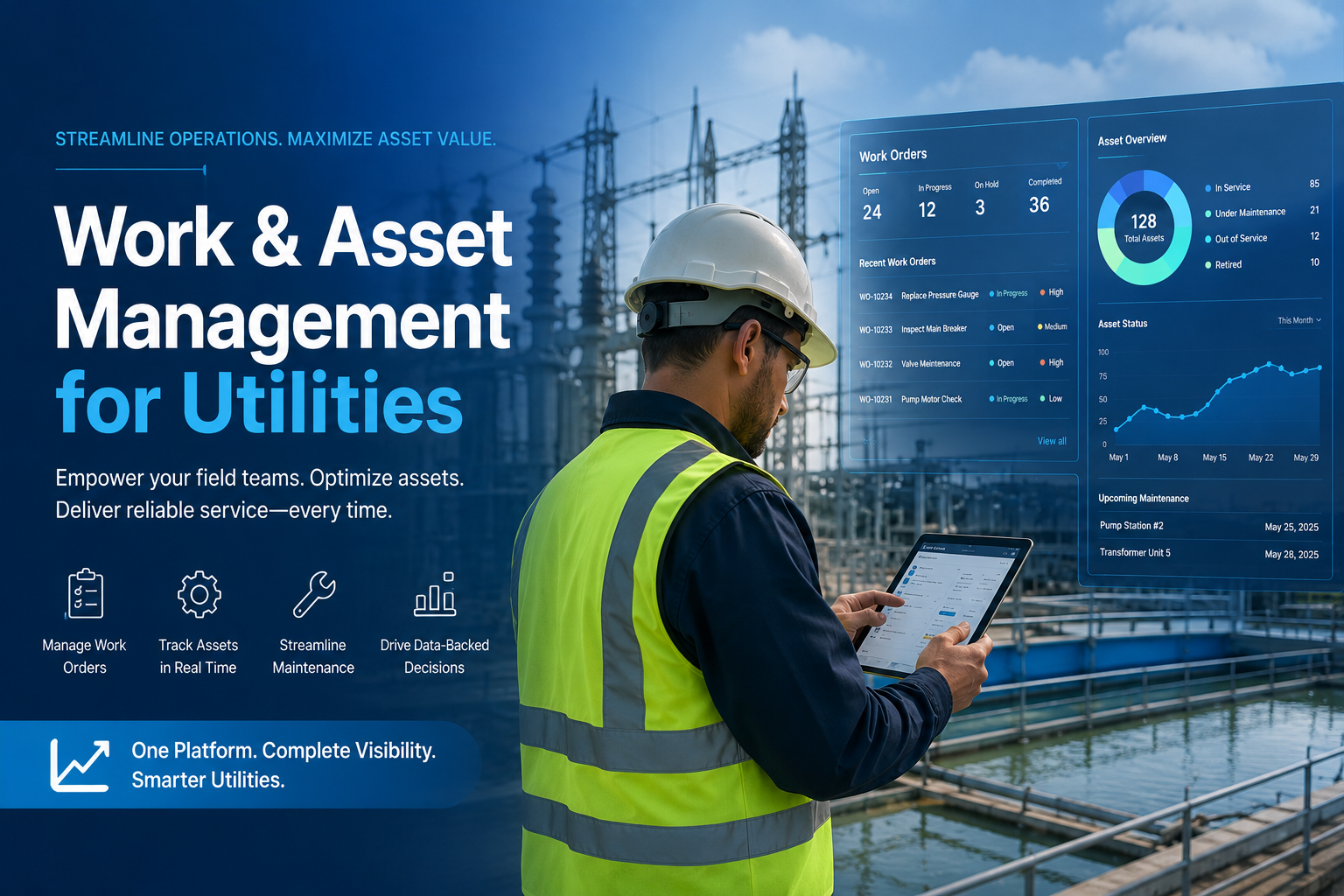
Work and asset management is the integrated approach of managing maintenance work activities alongside the lifecycle of physical assets. In a utility company, this means planning and executing work (like inspections, repairs, or upgrades) in coordination with managing assets such as transformers, pipelines, or meters throughout their lifespan. Work and asset management helps teams maintain critical equipment efficiently, minimize downtime, and keep assets performing at their best. In this blog, we will explore what work and asset management entails, why it’s crucial for utility operations, and how the Olix365 asset management module provides a utility-focused solution for effective work and asset management.
What is Work and Asset Management?
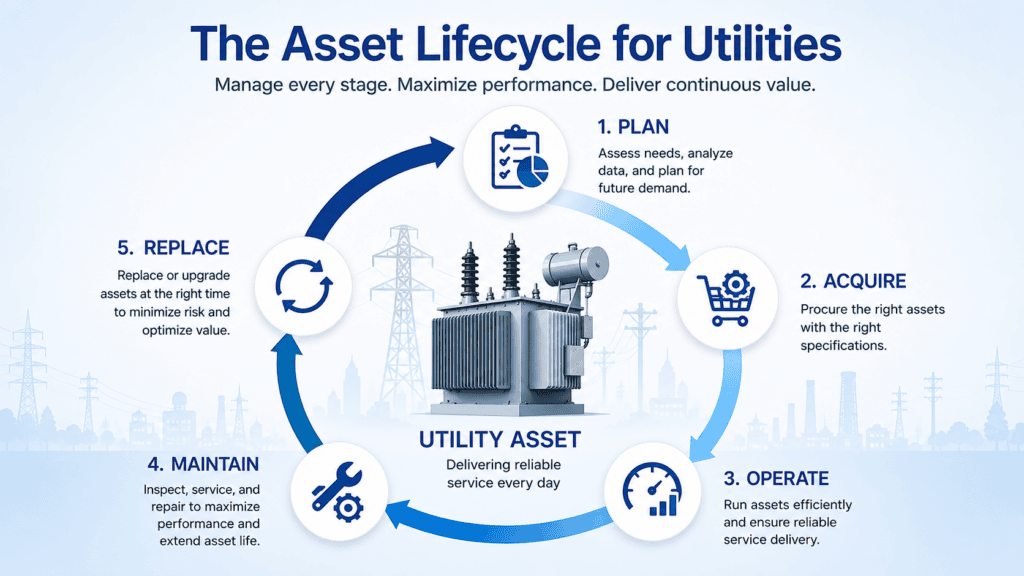
Work and asset management (often abbreviated as WAM) refers to the practices, processes, and tools that coordinate work management (the scheduling and execution of maintenance tasks or work orders) with asset management (tracking and optimizing the use and health of physical assets). Instead of treating maintenance work and asset upkeep as separate silos, WAM integrates them in one system. This integration helps companies efficiently manage their physical assets (equipment, infrastructure, facilities) throughout the asset lifecycle while also managing the work needed to keep those assets running.
In essence, a work and asset management system provides a single source of truth for both asset information and work history. For example, with WAM software, maintenance teams track asset locations, conditions, and completed or upcoming work in one place. By having this combined view, organizations can improve asset reliability, reduce unplanned downtime, and extend asset lifespans through proactive maintenance . The system links every maintenance task directly to an asset record, ensuring complete traceability.
Industry solutions like Oracle Utilities Work and Asset Management underscore the importance of this integration. They note that effective work and asset management supports the full asset lifecycle and helps increase maintenance efficiency, predict and prevent problems, extend asset life, and reduce costs across all assets . In other words, a strong work and asset management practice makes maintenance more efficient and assets last longer while controlling costs . It’s a critical part of modern utility management strategy.
Why it is essential ?
Utilities (such as electric, water, gas, and telecom companies) have a vast network of aging infrastructure and equipment that must be maintained. Implementing a robust work and asset management approach is especially important in this sector for several reasons:
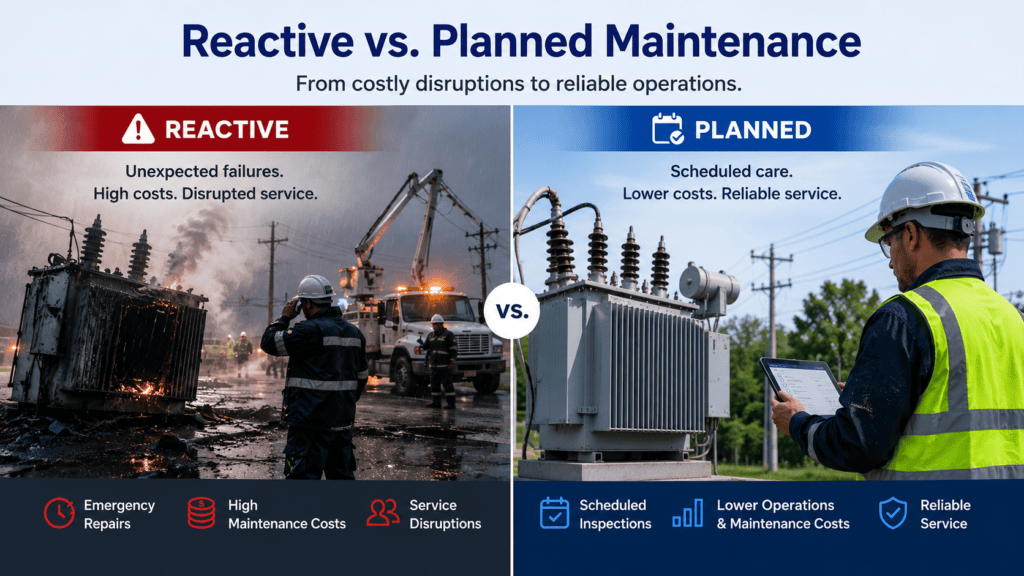
- Reliability and Uptime: Utility services must run 24/7, so equipment failures can cause outages or service disruptions. A robust WAM system increases asset reliability and availability by prompting teams to maintain equipment before failure occurs. By coordinating work schedules with asset condition data, utilities can perform preventive maintenance and avoid unexpected breakdowns that lead to downtime .
- Cost Reduction: Maintenance work can be costly, especially if done reactively (fixing things only after they break) or if overdone without need. Work and asset management reduces maintenance costs by optimizing when and how teams perform each task. Scheduling tasks at the right time (not too late to avoid failures, but not too early to avoid waste) means labor and materials are used more effectively. Utilities also save money by extending asset life – if assets last longer before needing replacement, capital expenditure is reduced.
- Regulatory Compliance: Utility companies operate under strict safety and reliability regulations. An integrated system simplifies record-keeping and helps teams complete inspections on time. Effective work and asset management helps maintain regulatory compliance by tracking required maintenance, inspections, and documentation in one place . This means when an auditor asks for proof of maintenance on a substation or pipeline, the information is readily available.
- Data-Driven Decisions: Combining work and asset data allows utilities to see trends and make informed decisions. For instance, a WAM system can highlight if a particular type of pump fails more often, prompting engineering teams to investigate or replace that asset type. Modern work and asset management solutions often provide analytics and reporting tools to support these data-driven decisions . Utilities can prioritize investments (e.g. deciding whether to refurbish an asset or buy a new one) based on real data about asset performance and maintenance history.
- Balanced Maintenance Strategy: Without an integrated approach, utilities might fall into extremes – either purely reactive maintenance or overly rigid preventive maintenance. Reactive maintenance often waits for assets to fail, putting system reliability at risk. On the other hand, a strictly time-based preventive regime might replace parts too early or perform unnecessary work, wasting labor and materials . A work and asset management system encourages a balanced, condition-based maintenance strategy. The system schedules maintenance based on asset condition and criticality instead of a fixed calendar or failure triggers. This balanced approach improves efficiency by avoiding both unplanned outages and excessive maintenance.
In summary, utilities rely on work and asset management to boost service reliability, cut costs, ensure compliance, and optimize how and when teams perform maintenance. As one industry expert put it, utilities benefit most from “a lifecycle work and asset management continuum” – a continuous process of planning work and monitoring assets together as the best practice for managing utility operations .
Key Features
To achieve the above benefits, a work and asset management system (often implemented as software or part of an enterprise solution) typically offers several key features:
- Asset Registry & Lifecycle Tracking: A centralized inventory of all assets (equipment, machinery, infrastructure), with details like location, status, age, maintenance history, and expected lifespan. This helps track each asset from purchase or installation through maintenance, upgrades, and eventually decommissioning. Users should be able to see an asset’s entire story at a glance.
- Work Order Management: The ability to create, schedule, assign, and track work orders for maintenance tasks. This includes preventive maintenance schedules (routine inspections, tune-ups), corrective maintenance (repair jobs), and even predictive maintenance tasks.
Teams use a calendar or visual schedule board to plan work and dispatch crews efficiently. The system links each work order to its asset, giving everyone visibility into completed and upcoming tasks. Work orders are linked to the relevant assets, so anyone can see what work has been done or is upcoming for each asset.
- Preventive and Predictive Maintenance: Tools to schedule regular maintenance based on time or usage (e.g. service each generator every 6 months or every 1000 hours of run-time). More advanced systems incorporate condition-based or predictive maintenance – using sensor data and analytics to predict failures before they happen . For example, if vibration or temperature sensors on a transformer indicate an anomaly, the system can trigger a work order for inspection before a breakdown occurs. This proactive approach, supported by IoT data and even AI algorithms, helps prevent costly failures and reduce downtime .
- Resource and Inventory Management: Integration with inventory and procurement systems to ensure that spare parts, tools, and materials are available for scheduled work. A robust WAM system increases asset reliability and availability by prompting teams to maintain equipment before failure occurs. It can also track labor resources and skills – ensuring the right technicians are assigned to the right jobs. For utilities with field crews, features like route optimization help plan efficient travel paths for technicians to multiple work sites , saving time and fuel.
- Compliance and Safety Tracking: Built-in checklists and record-keeping for regulatory compliance. For instance, the system can log inspections or safety tests required by law and alert managers if any are overdue. It can also store documents, permits, or images related to work for auditing purposes. This feature is critical in utilities where safety regulations are strict.
- Analytics and Reporting: Dashboards and reports that give insight into asset performance and maintenance KPIs (Key Performance Indicators). For example, utilities might track metrics like mean time between failures (MTBF) for assets, maintenance backlog, or cost per work order. An effective work and asset management module provides these analytics so management can identify trends and make improvements. Having historical data in one place also allows for smarter budgeting and asset investment planning (deciding when it is more cost-effective to replace an asset versus keep repairing it).
- Integration with Other Systems: Work and asset management does not exist in isolation. The system connects directly with financial, customer, and GIS platforms — tracking maintenance costs, linking outages to asset issues, and mapping asset locations in real time.These integrations let maintenance activities automatically trigger other processes, such as creating purchase requests for asset replacements.In a comprehensive utility ERP like Olix365, the asset management module connects with modules for procurement, inventory, project management, HR, and more . This ensures that maintenance activities can seamlessly trigger other processes (e.g., if an asset needs replacement, a purchase request can be initiated).
User-Friendly Interface and Mobility: (While avoiding the cliché “user-friendly”, this simply means the software is easy to use.) Technicians in the field often use mobile devices or tablets, so a modern WAM system typically provides a mobile app or web interface for field use. This allows crews to receive work orders, update status, record asset data (like a photo of a faulty part) on-site, and even work offline if needed. Ease of use and mobile access increase the likelihood that data is recorded accurately and promptly during maintenance work.
All these features work together to give an organization a complete view of work and asset management. When evaluating a solution, utilities should look for the ability to cover the full asset lifecycle, support maintenance planning, and integrate with their existing workflows and systems.
Olix365 Asset Management Module
Olix365 includes an asset management module built for utility businesses, combining all essential capabilities in one unified platform. As part of the cloud-based ERP suite, Olix365 aligns its work and asset management features with the specific needs of power utilities, water authorities, and other essential service providers. Here’s how the Olix365 asset management module supports effective work and asset management:
- Lifecycle Management for Utility Assets: Olix365 Asset Management is designed to help utilities manage the lifecycle of physical assets such as equipment, machinery, and infrastructure, ensuring optimal performance and longevity . This means the module enables tracking each asset from installation through maintenance to replacement. Utilities can store detailed asset information (manufacturer, install date, capacity, etc.) and update its condition and value over time. By doing so, Olix365 helps utility managers foresee when an asset might need an upgrade or more frequent check-ups to keep performing at its best.
- Integrated Work Management: The Olix365 module doesn’t handle assets in a vacuum – it links tightly with work management. Maintenance teams can use Olix365 to create and schedule work orders for inspections, repairs, and preventive maintenance. The visual schedule board and route optimization features in Olix365 allow dispatchers to plan out work efficiently . For example, if several water pumps in different locations are due for servicing, Olix365 can help plot the optimal route for a technician to service all those pumps in one trip, while reserving the necessary spare parts from inventory in advance. This level of integration ensures that work is coordinated with asset needs and field operations are carried out efficiently.
- Cross-Module Integration: One strength of Olix365 is that it’s a full ERP tailored for utilities. The asset management module connects with other modules like Inventory & Warehouse Management, Procurement, Project Management, Finance, and HR . In practical terms, this means when you schedule work on an asset, the system can check inventory for required parts, tie into procurement if new parts need ordering, account for the labor hours in project costing, and even ensure the technicians have the right certifications (via HR records). Such deep integration avoids the common silo problem — all departments see the same picture. For instance, after a repair is done, the finance module can automatically capture the expense, and the asset’s value or depreciation schedule can be adjusted accordingly in the asset registry.
- Cloud-Based and Scalable: Olix365 is a cloud-based solution , which brings advantages like faster deployment, regular updates, and access from anywhere. Utility companies, which often have distributed operations (multiple plants, field crews in various regions), benefit from the cloud approach because everyone can access the work and asset management system securely via the internet. Additionally, Olix365 is built to scale with the organization – whether a utility is managing a few hundred assets or hundreds of thousands, the system can handle the growth. Being cloud-based also means maintenance and upgrades of the software are handled by the provider, reducing IT burden on the utility.
- Regulatory Compliance and Reporting: Given its utility industry focus, the Olix365 asset management module includes robust compliance reporting. It can generate reports showing all maintenance activities performed on critical assets, which is useful for regulatory submissions or internal audits. Olix365 provides features like regulatory compliance reporting and dashboards to help utilities prove they have met standards and promptly identify any compliance gaps . For example, if a regulator mandates that all valves on a gas pipeline must be inspected annually, Olix365 can track those inspections and produce evidence of completion for each valve.
- Optimized Workflows and User Experience: While avoiding fluff words, it’s worth noting that Olix365 emphasizes making workflows easier for users. It offers optimized workflows and portals – meaning routine processes (like creating a work request or approving a maintenance schedule) are streamlined into a few clicks, and external stakeholders like vendors or customers can have limited portal access when appropriate (for instance, a contractor updating a work order status, or a customer submitting a service request that ties into asset maintenance). The interface is designed for the needs of utility operations, which helps with user adoption. Field technicians and office staff can collaborate through the system, seeing real-time updates on work progress and asset conditions.
In short, Olix365’s asset management module provides a comprehensive yet utility-specific work and asset management solution. It encapsulates best practices of the industry – from condition-based maintenance to integrated financial tracking – in one package. Because it’s purpose-built for utilities, companies don’t have to heavily customize a generic system; instead, they get out-of-the-box support for common utility scenarios (like route optimization for field crews or compliance reports for utility regulators) . This focus on utility needs can lead to faster implementation and quicker ROI for organizations adopting the system.
Work and asset management is a cornerstone of efficient utility operations. By unifying asset data with work processes, utilities can ensure that every piece of infrastructure is properly cared for at the right time and cost. Olix365’s asset management module exemplifies this integrated approach, enabling utility companies to move away from reactive fixes and towards proactive, smart maintenance strategies. The result is a more reliable service for customers, extended asset lifespans, and better use of maintenance budgets. Embracing a modern work and asset management solution like Olix365 not only improves day-to-day maintenance workflows, but also sets utilities up for long-term success in managing their vital assets.
FAQs
What is work and asset management in simple terms?
Work and asset management is the practice of managing maintenance work (like repairs, inspections, and tasks) in tandem with managing assets (equipment, machines, infrastructure). Instead of handling these separately, a work and asset management system links work orders to the physical assets. This ensures all maintenance activities are planned and recorded against the assets, helping organizations keep equipment running efficiently and for a longer time.
How is work and asset management different from traditional maintenance management?
Traditional maintenance management might focus on scheduling work orders and fixing issues as they arise, often without a comprehensive view of the asset’s history or condition. Work and asset management is more integrated – it not only schedules and tracks maintenance work, but also keeps a detailed record of each asset’s lifecycle. This integration means decisions about maintenance are informed by asset data (age, condition, performance) and maintenance history, leading to more proactive and informed upkeep than a reactive approach.
Why do utility companies need work and asset management specifically?
Utility companies manage a large number of critical assets (power lines, transformers, water pipes, etc.) spread over wide areas, and they must ensure high reliability. Work and asset management helps utilities by coordinating all maintenance work with asset information. This results in fewer unexpected outages (since maintenance is planned proactively), optimized use of crews and equipment (saving costs), and compliance with safety regulations. Essentially, it gives utilities a framework to extend the life of infrastructure and provide uninterrupted service to customers.
What features should I look for in a work and asset management software?
Key features include an asset registry (a database of all assets with details), work order management (creating and tracking maintenance tasks), preventive maintenance scheduling (routine service reminders), predictive maintenance capabilities (using sensor data to foresee failures), inventory and spare parts management, scheduling tools (like calendars or dispatch boards for field work), and reporting/analytics. Integration with other systems (like finance and inventory) is also important so that maintenance activity is connected with budgeting, purchasing, and stock levels. A user-friendly mobile interface is a plus, since technicians often need to update work status in the field.
How does the Olix365 asset management module support work and asset management?
Olix365’s asset management module is built for utilities to manage both work and assets in one platform. It allows you to track each asset’s details and history, schedule and assign maintenance work orders, and ensure needed parts and resources are available for the job. Olix365 includes tools like a visual scheduling board and route optimization for field crews, integrates with inventory and purchasing for spare parts, and provides compliance reporting. Because it’s part of a larger ERP, it connects maintenance with other business processes, giving a complete picture of operations.
Can work and asset management reduce downtime and costs?
Yes, that’s one of its main benefits. By planning maintenance proactively (fixing things before they break) and by optimizing the scheduling of work, a work and asset management approach reduces unexpected equipment failures (thus less downtime). It also avoids wasting money on unnecessary maintenance by using data to drive decisions (so you’re not, for example, replacing a part too frequently if the data shows it’s still in good condition). Over time, better maintained assets last longer and operate more efficiently, which lowers the total cost of ownership. Plus, efficient scheduling means less overtime and better use of labor and materials, further controlling costs.