Utility operations have always been demanding. Aging infrastructure, growing service expectations, and tighter regulatory requirements leave little room for guesswork. For years, many utilities relied on scheduled maintenance – inspecting and replacing equipment on a fixed calendar, regardless of actual condition.
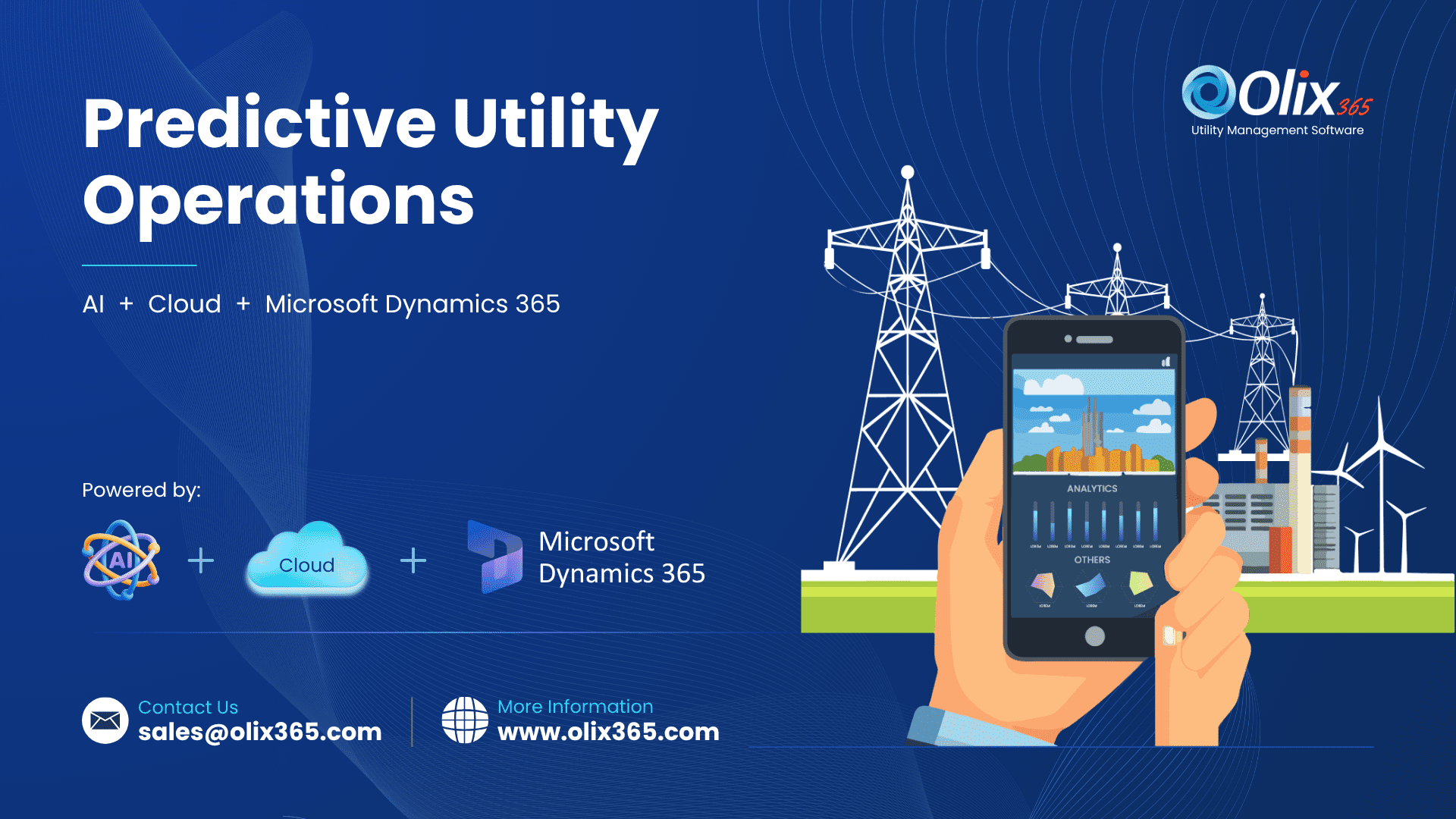
That approach is expensive and, more importantly, unreliable. Predictive utility operations offer a better path. By connecting real-time asset data with AI-driven analytics inside Microsoft Dynamics 365, utility teams can identify problems before equipment fails. The result is fewer outages, lower maintenance costs, and more confident planning.
This article explains what predictive utility operations actually means, how AI fits into the picture, and how a purpose-built ERP like Olix365 makes this possible for utility organizations today.
What “Predictive Utility Operations” Actually Means
Predictive utility operations means using data to make maintenance decisions based on actual asset condition not on a fixed schedule.
Instead of replacing a transformer every five years regardless of its health, a predictive approach monitors voltage patterns, oil temperature, and load history continuously. When those readings move outside normal ranges, the system generates a work order automatically. The maintenance team acts before failure, not after.
This is different from preventive maintenance, which still runs on a calendar. It is also different from reactive maintenance, which waits for something to break. Predictive utility operations sit between the two – precise, data-driven, and cost-aware.
According to recent industry research, utilities that adopt AI-powered predictive maintenance can reduce equipment failures by up to 73% and cut unplanned downtime by around 40%. For a utility managing hundreds of distributed assets, those numbers translate directly into budget savings and service reliability.
Why Traditional Maintenance Schedules Fall Short
Most utility teams are familiar with the problem. Scheduled maintenance treats every asset the same. A pump that has run perfectly for three years gets inspected on the same cycle as one showing early signs of wear. Resources go where the calendar says to go, not where the risk actually is.
There are three reasons this becomes a costly habit over time.
First, it ignores real asset data. Sensors, smart meters, and operational logs already collect thousands of data points per asset per day. However, without a system that can read and act on that data, the information sits unused.
Second, it creates unnecessary maintenance spend. A city water department that replaced pumps every four years discovered — after implementing a data-connected system — that many pumps could safely run for six years with basic servicing. Several outliers needed early replacement, but the majority had been swapped out too soon.
Third, it leaves teams in reactive mode. When an asset fails unexpectedly, field crews respond under pressure. Emergency call-outs are costly, and unplanned downtime can mean regulatory violations, customer complaints, and repair bills that dwarf what a planned intervention would have cost.
Predictive utility operations address all three of these gaps directly.
How AI Works Inside a Utility ERP

AI-powered utility asset management does not require a separate analytics platform bolted onto your existing systems. When built into a utility ERP like Microsoft Dynamics 365, it works inside the modules your teams already use every day.
Here is how the key components connect.
IoT Sensors and Real-Time Data Collection
Assets in the field – transformers, pumps, meters, and substations – collect data continuously through IoT sensors. That data flows into Azure IoT Hub, where it is processed and fed into Dynamics 365 Field Service. When sensor readings cross defined thresholds or show anomaly patterns, the system creates a work order automatically.
One electric utility configured automated alerts in Dynamics 365 for transformer anomalies — unusual usage patterns, rising temperatures, irregular load cycles. Maintenance teams started intervening before failures occurred. Emergency field calls dropped by 38%.
Machine Learning Models That Improve Over Time
The value of AI in this context is not just the alert. It is the ability to learn from each maintenance outcome. When a technician completes a repair and logs the root cause, parts used, and resolution time, that information feeds back into the model. Over time, the system becomes better at flagging similar conditions on similar assets — before human observers would notice them.
Microsoft Copilot for Faster Decision-Making
Microsoft’s 2026 Release Wave 1 brings significant AI improvements to Dynamics 365. Microsoft Copilot now works across Finance, Field Service, and Project Operations as a conversational assistant. A field service manager can ask Copilot in plain language — “Which assets in the Northern district are showing anomalies this week?” — and receive a summary drawn from live ERP data.
This is not a separate AI tool. Copilot works as a side panel inside the same Dynamics 365 screens your team already uses, which means adoption is faster and context is not lost between systems.
The Connected Ecosystem: Assets, Finance, and Field Service

One of the most practical advantages of predictive utility operations in Dynamics 365 is the connection between departments that traditionally operated in silos. When an IoT sensor flags a failing pump, the following chain of events can happen automatically:
A work order is created in Dynamics 365 Field Service. The nearest qualified technician is scheduled based on skills, travel time, and current workload. The required parts are checked against inventory in Supply Chain Management. A purchase order is raised if the part is not in stock. The maintenance cost is tracked and posted to the correct asset account in Dynamics 365 Finance.
By the time the technician arrives on site, the work order, asset history, and required documentation are already on their mobile device. When the job is complete, they log the outcome on-site. The asset record updates instantly.
This is what Olix365 is built to do — take the Dynamics 365 platform and configure it specifically for utility workflows from day one. Utilities do not need to build these connections from scratch. Olix365 ships with preconfigured workflows, industry KPIs, and module integrations that reflect how utility operations actually work.
What This Looks Like for Utility Finance Teams
Predictive utility operations are not just an operations story. They are a finance story too.
Utility finance teams manage multi-year capital budgets, asset depreciation schedules, and regulatory reporting simultaneously. When maintenance is unplanned, it disrupts budget forecasts and creates variance that is difficult to explain to boards and regulators.
Proactive maintenance changes the financial picture in three ways.
Budget accuracy improves. When asset health data informs maintenance schedules, finance teams can plan with greater confidence. Capital expenditure decisions are based on real asset lifecycle data, not estimates.
Depreciation tracking becomes more accurate. Dynamics 365 Finance links asset records to maintenance logs. If a pump’s useful life is extended from four years to six based on actual condition monitoring, that change is reflected in the depreciation schedule automatically.
Audit readiness is built in. Dynamics 365 maintains complete audit trails — every work order, cost posting, and approval step is logged. For utilities that face regulatory scrutiny, this is a meaningful operational advantage.
The Olix365 Finance module extends these capabilities with dashboards and workflows built specifically for utility financial roles — CFO dashboards, regulatory reporting templates, and multi-year projection tools.
From Field Service to Data-Driven Scheduling
Field technicians have historically worked from printed job sheets, manually updated logs, and back-office systems they could only access at the depot. That model creates lag — hours or days between a completed job and an updated asset record.
Dynamics 365 Field Service changes this. Technicians use a mobile interface to pull up full asset history before touching any equipment. They log repairs on-site. Records update in real time. Parts used are deducted from inventory automatically.
For utility operations managers, this means the data coming back from the field is clean and current. Scheduling decisions the following week are based on accurate information. Assets that need attention appear in the dashboard because the field data says so — not because someone remembered to file a report.
Microsoft’s Connected Field Service approach integrates IoT signals directly with this scheduling workflow. Work orders generated from asset health data carry priority rankings. A technician’s schedule is not just efficient in terms of travel time — it is prioritized by actual asset risk.
Implementation: What Utilities Should Expect
A common concern among utility operations leaders is the complexity of getting from where they are to where this article describes. Legacy systems, data quality issues, and stretched IT teams are real obstacles.
There are practical steps that reduce the risk.
Start with data quality. Predictive models are only as good as the data they run on. Before deploying AI-driven maintenance workflows, clean and standardize your asset data. Identify which assets generate the most maintenance cost and focus initial efforts there.
Migrate in phases. Olix365 is built on Microsoft Dynamics 365 and supports phased migration from legacy systems, including Dynamics GP. The process covers data profiling, field mapping, migration execution, and post-go-live support. Utilities do not have to replace everything at once.
Use the preconfigured workflows. One of the practical benefits of an industry-specific ERP like Olix365 is that the core utility workflows work order management, asset tracking, field scheduling, regulatory reporting – are already configured. Teams spend less time on setup and more time on adoption.
Measure what matters. Asset availability, unplanned downtime per month, and maintenance cost per production hour are the three metrics that reveal whether predictive utility operations are delivering value. Set baselines before go-live and track against them quarterly.
Key Takeaways
Predictive utility operations is a practical, measurable approach to managing utility assets more effectively. The technology — AI, IoT sensors, Microsoft Dynamics 365, and Microsoft Copilot — is mature and available now.
The utilities that move early on this will carry a compounding advantage. Each maintenance cycle produces data that makes the next cycle more accurate. Assets last longer. Budgets are more predictable. Field teams spend their time on work that matters, not on emergency call-outs.
Olix365 is built specifically to make this possible for utility organizations of every size — from regional distributors to large municipal providers — without years of custom development or heavy IT dependency.
If your team is evaluating how to move from scheduled maintenance toward a more data-driven model, this is the right time to explore what a utility-ready ERP can do.