Financial management in a utility company is fundamentally different from a typical commercial business. Utilities operate under price controls, capital expenditure programmes, regulatory ring-fencing requirements, and complex cost allocation rules that span operational assets, contracted services, and large infrastructure projects simultaneously.
Generic finance systems force finance teams into workaround after workaround – custom spreadsheets to allocate maintenance costs to regulated vs. non-regulated activities, manual journal entries to reconcile project expenditure, and month-end processes that take two weeks instead of two days.
Dynamics 365 Finance, configured specifically for the utilities sector by Olix365, provides the chart of accounts structure, cost centre framework, project accounting, and regulatory reporting capabilities that utility finance teams actually need – without the spreadsheet gymnastics.
What This Guide Covers: Setting up Dynamics 365 Finance for a utility company – chart of accounts, financial dimensions, project cost tracking, automated AP/AR workflows, and regulatory reporting structures.
How Dynamics 365 Finance Connects Across the Utility Enterprise
Before diving into configuration, it is important to understand how Dynamics 365 Finance integrates with the operational modules:
- Asset Management → Finance: Every maintenance work order posts actual labour and material costs to the general ledger via cost centres linked to the asset’s functional location.
- Field Service → Finance: Time entries from field technicians flow through Project Accounting or directly to expense accounts.
- Procurement → Finance: Purchase orders, goods receipts, and vendor invoices post automatically to the GL without manual journal entry.
- Billing/AR → Finance: Customer invoices (for utilities that bill directly, such as connection fees, metered services) post to accounts receivable and generate automatic payment reminders.
This integration eliminates the month-end reconciliation effort that consumes finance teams in legacy ERP environments. Our article on improving utility financials with Dynamics 365 explains the financial transformation in more detail.
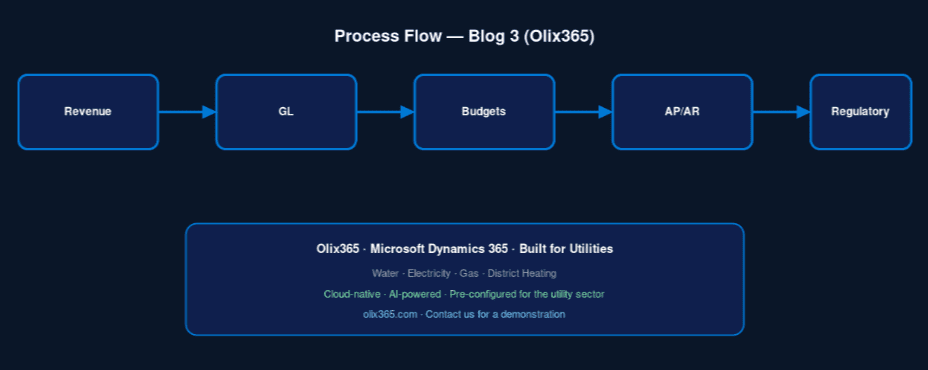
Step 1: Design Your Chart of Accounts for Utility Operations
The chart of accounts for a utility company should reflect the regulatory and operational reality of the business. Key account structure considerations:
Regulatory segmentation: In many jurisdictions, utilities must ring-fence their regulated network activities from commercial or non-regulated services. Use financial dimensions (see Step 2) rather than separate account codes to achieve this it keeps your account structure manageable while enabling granular regulatory reporting.
Recommended top-level structure:

Step 2: Configure Financial Dimensions
Financial dimensions are the key to flexible, multi-dimensional reporting without a complex account code structure. For utilities, configure the following dimensions:
- Business Unit: Water, Electricity, Gas (for multi-utility organisations)
- Cost Centre: Network Operations, Finance, HR, IT, Customer Services
- Project: Capital project codes for infrastructure programmes
- Regulatory Segment: Regulated, Non-Regulated, Shared Services
- Asset Class: Distribution, Transmission, Generation, Treatment
Dimensions are attached to every journal entry, purchase order line, and work order cost posting. This means a single maintenance cost can be reported by cost centre, project, asset class, and regulatory segment simultaneously without duplicating account codes.
Step 3: Set Up Budgeting and Budget Control
Dynamics 365 Finance includes a flexible budgeting module that utilities use for:
- Navigate to Budgeting → Setup → Budget Configuration.
- Create budget cycles aligned to your financial year and regulatory period.
- Enable Budget Control to enforce spending limits – when a purchase order would exceed the approved budget for a cost centre, it triggers an approval workflow rather than posting automatically.
- Configure Budget Revisions to handle the inevitable mid-year adjustments that occur in capital projects.
- Use Budget Register Entries to import the approved capital programme and operational budgets from your planning tool.
Tip: For regulated utilities, configure separate budget cycles for CapEx and OpEx aligned to your regulatory submission periods. This enables direct comparison of actual spend against the regulatory allowance without additional Excel workbooks.
Step 4: Automate Accounts Payable for Contractor and Supplier Invoices
Utility companies typically have a high volume of contractor and supplier invoices – maintenance contracts, capital works, equipment purchases, and specialist services. Automating AP reduces processing cost and eliminates late payment penalties:
- Vendor portal setup: Enable the Vendor Collaboration Portal so contractors can submit invoices directly into Dynamics 365 without email or paper.
- Three-way matching: Configure automatic matching of purchase orders, goods receipts, and invoices. Invoices within tolerance post automatically; exceptions route to an approver.
- Payment scheduling: Set up payment runs aligned to your payment terms (e.g., weekly BACS run for 30-day terms).
- Early payment discounts: Configure automatic capture of supplier early payment discounts, which can represent significant savings for utilities with large procurement spend.
Step 5: Configure Project Accounting for Capital Works
Utility capital programmes new mains, substation upgrades, meter replacements – require project accounting to track costs against approved budgets, capitalise assets at completion, and report progress to regulators and investors.
In Dynamics 365 Finance, configure:
- Project Groups: Capital Works, Refurbishment, New Connection, R&D
- Cost Categories: Labour, Plant Hire, Materials, Design, Supervision
- WBS (Work Breakdown Structure): Align to your project management methodology (Prince2, PMBoK)
- Revenue Recognition: For projects with milestone-based billing (e.g., new connection fees)
When a project is complete, use the Fixed Asset Capitalisation function to transfer the accumulated project cost from the WIP account to the appropriate fixed asset category, triggering depreciation automatically.
Step 6: Build Regulatory and Management Reporting
Dynamics 365 Finance integrates with Power BI to deliver the reporting layers that utility finance teams need:
Management accounts: Monthly P&L and balance sheet by business unit and cost centre, with variance analysis against budget.
Regulatory reporting: Separation of regulated vs. non-regulated costs for submission to the economic regulator, with the dimensional breakdowns needed to complete standard regulatory templates.
Capital programme reporting: Actual vs. budget by project, forecast to completion, and capitalisation status.
Cash flow forecasting: Rolling 13-week cash flow based on confirmed purchase orders, payroll runs, and expected receipts.
Olix365 includes pre-built Power BI finance dashboards designed to the reporting formats used by water, electricity, and gas regulators in the UK, Australia, Canada, and the Middle East.
Conclusion
Dynamics 365 Finance, configured for the specific requirements of utility companies, eliminates the spreadsheet-heavy workarounds that slow down utility finance teams and increase the risk of reporting errors. With the right chart of accounts, financial dimensions, and automated AP/AR workflows, your finance team can close the month in days rather than weeks – and produce regulatory reports with a few clicks rather than manual extraction.
Talk to the Olix365 finance team to discuss your financial management requirements.
FAQs
Does Dynamics 365 Finance support multiple currencies for utilities operating in different countries?
Dynamics 365 Finance has comprehensive multi-currency support including transaction currency, accounting currency, and reporting currency. Exchange rates can be loaded automatically from provider feeds, and revaluation of foreign-currency balances at period-end is automated. For utilities operating across multiple jurisdictions, this is essential for consolidated group reporting.
How does Dynamics 365 Finance handle the regulatory ring-fencing requirements that many utilities face?
Ring-fencing is achieved through financial dimensions rather than separate legal entities (though separate legal entities are also supported). By consistently tagging all transactions with a Regulatory Segment dimension (Regulated/Non-Regulated/Shared), you can produce ring-fenced accounts that demonstrate compliance with your licence conditions. Olix365 configures the default dimension rules so that transactions automatically inherit the correct regulatory segment based on the cost centre or asset class.
Can we integrate our existing billing system with Dynamics 365 Finance?
Yes. Dynamics 365 Finance provides integration APIs (OData, REST) that allow billing amounts from a separate Customer Information System (CIS) or metering platform to post automatically to accounts receivable. Olix365 has pre-built integrations for several common utility billing platforms. Alternatively, Olix365's own billing module can replace a standalone CIS entirely.
How long does a typical Dynamics 365 Finance implementation take for a utility company?
A standard Olix365 Finance implementation for a mid-size utility (50–500 employees) typically takes 3–6 months from kick-off to go-live, depending on data migration complexity and the number of integrations required. Olix365's pre-configured utility templates significantly reduce configuration effort compared to a greenfield Dynamics 365 implementation.
Does Dynamics 365 Finance support fixed asset management and depreciation?
Yes. Dynamics 365 Finance includes a comprehensive fixed asset module that handles multiple depreciation methods (straight-line, reducing balance, units of production), asset revaluation, componentisation (splitting a complex asset into separately depreciable components), and disposal. For utilities with large asset bases, this module is essential for accurate balance sheet reporting and regulatory asset value calculations.